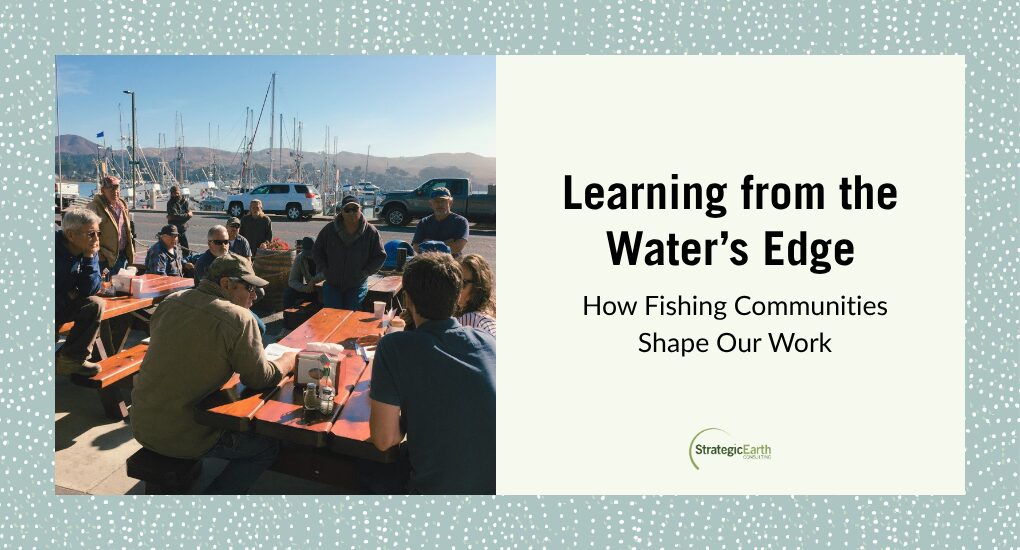
The first time I sat across from a commercial fisherman to talk about the California Dungeness crab fishery and what that work meant to his identity and livelihood, I realized quickly that I was the one who needed to listen.
That lesson has stayed with me throughout my career and continues to shape how we approach community engagement at Strategic Earth today.
It was 2008. As a Sea Grant Fellow for the California Ocean Protection Council, I was early in my career and eager to bring my scientific background into the world of policy. What I hadn’t yet learned was how essential it would be to also learn from the people who work in fisheries and on the ocean every day. This fisherman was a lifelong crabber. He understood not just how to catch crab, but also how the ocean, the economy, and the people around him shaped the fishery itself. He understood complex ocean changes and long-term trends that scientists were just beginning to describe in scientific papers. Within an hour, he’d taught me more about Dungeness crab fishery management and biology than any textbook or policy paper could have.
How Strategic Earth Began Working with Fishing Communities
My work with OPC led me to administer and support the California Dungeness Crab Task Force, navigating some of the most complex and contentious fisheries management conversations on the West Coast. At the start of her consulting career, Kelly served as the outreach and education coordinator for California’s Marine Life Protection Act (MLPA) Initiative, working directly with fishing communities, Native Nations, agencies, local governments, environmental groups, and the broader California community on the state’s landmark marine protected area planning process.
These experiences shaped our work and the evolution of Strategic Earth. Over time, we learned that our role wasn’t to advocate for a single perspective. It was to create the conditions for productive dialogue among people who often approached fisheries issues from very different experiences and priorities.
When we came together in 2010, Kelly and I brought our experiences working with fishing communities with us, along with a shared belief: that meaningful engagement with fishing communities is not a step in the process. Rather, it is foundational to finding common ground and working together to get marine resource management right.
Why Fishing Community Engagement Matters
Fishing communities are the constant eyes and ears on the water. Fishermen observe the ocean across seasons, years, and decades in ways that no monitoring program can replicate. Their knowledge of species behavior, habitat conditions, and ecological change is irreplaceable and critical to solving some of the most complex natural resource challenges of our time, from changing ocean conditions to fisheries sustainability to whale entanglements.
When decision-making processes don’t meaningfully include fishing communities, proposed solutions often miss important on-the-water realities. Trust erodes, and the people most affected by coastal and ocean policy must live with outcomes they had no hand in shaping.
What Effective Engagement with Fishing Communities Looks Like
At its core, thoughtful engagement means seeing people as people. Recognizing that everyone at the table brings something valuable, even when their worldview or lived experience looks different from those sitting across from them. A fisherman who has worked the same stretch of coast for thirty years holds knowledge that is irreplaceable, and thoughtful engagement honors that. It means being transparent about what we know and what we don’t, being clear about trade-offs, and being willing to say when decisions ultimately come down to values, not just data.
It also means showing up consistently over time. Fishing communities have experienced their share of outreach that was really just notification. We build credibility by following through, engaging fishing communities, sharing results even when they’re complicated, and returning as ongoing partners rather than periodic contacts. When people feel genuinely seen and respected in a process, they engage differently, and the outcomes are better for it.
What We’ve Learned
This work has taught us many things, but perhaps the most important is also the simplest: fishermen love the ocean.
The narrative that pits fishing communities against ocean conservation is, more often than not, a false one. The fishermen we’ve worked with want healthy fisheries, clean water, and thriving ecosystems. This is not just for their livelihoods, but because the ocean is part of who they are. Their desired outcomes frequently align closely with those of environmentalists, scientists, and agencies, even when the path to getting there looks different. When we create space for genuine dialogue rather than entrenched debate, we almost always find more common ground than divides us.
We’ve also learned that honesty, integrity, and transparency are not just professional values: they are the foundation on which everything else is built. Fishermen and coastal communities don’t need to agree with every policy outcome. But they need to trust that others see the value they bring to the process and the people in the room. When that trust exists, durable solutions become possible. When it doesn’t, even the best-designed policies struggle to take hold.
Again and again, we’ve learned that the challenge is rarely getting people to care. Most people already care deeply. The challenge is creating the conditions where people can hear one another, understand one another, and work toward shared outcomes.
If you’re navigating complex fisheries, coastal, or ocean management challenges and looking for ways to build trust across diverse interests, we’d love to connect. Strategic Earth brings over fifteen years of experience helping agencies, organizations, and communities find common ground on the water.
We used ChatGPT in a limited editorial capacity to support document organization, readability, and flow. Humans generated all ideas and content, and the Strategic Earth team reviewed, edited, and finalized this post.